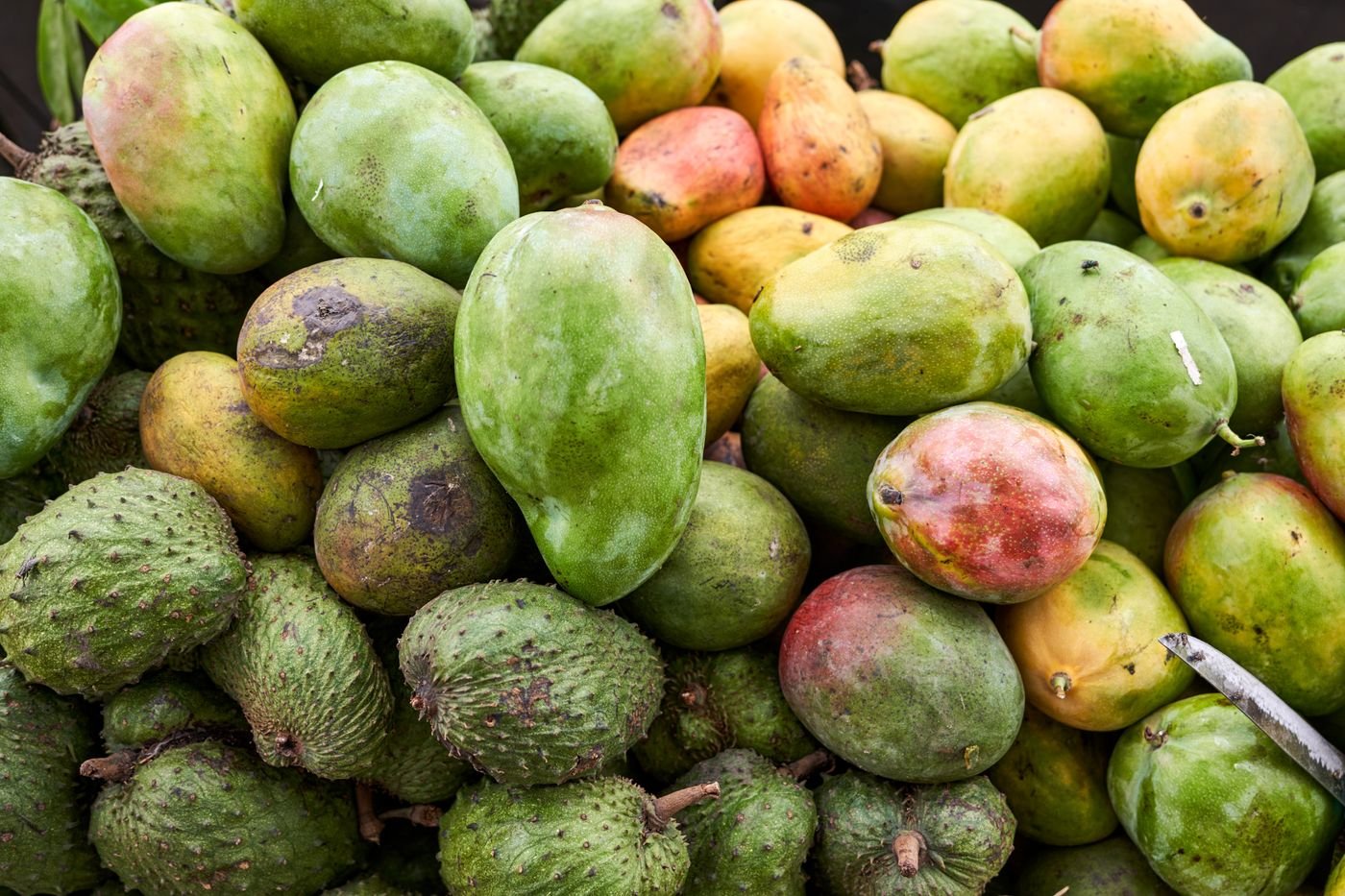
By midsummer our counters are covered in mangoes in every stage of ripeness, and the question we get asked most in the test kitchen is not how to cook them but how to keep up with them before they turn. A single productive tree can produce more fruit in a few weeks than any household can eat fresh, so the real skill is not picking a good mango. It is knowing what to do with forty of them at once.
Picking by feel, not color
Color is the least reliable way to judge a mango, since different varieties turn different shades and some stay green even when fully ripe. We go by feel and smell instead. A ripe mango gives slightly under gentle pressure near the stem end, the way a ripe avocado does, and it usually smells faintly sweet at the stem if you hold it close. A rock hard mango will ripen on the counter in a few days, out of direct sun, and a paper bag speeds that up if you are in a hurry.
Once a mango is ripe, the clock starts running fast in a warm kitchen. We try to process anything ripe within a day or two, either eating it, cutting it for the fridge, or freezing it, because a mango that goes from perfect to overripe can do so overnight once the weather warms up.
The cutting method that saves your fingers
The flat, wide pit in the center of a mango trips up a lot of home cooks, so we stick to one method every time. Stand the mango on its stem end and slice down on either side of the pit, close to the center, which gives you two large sections we call cheeks. Score the flesh of each cheek in a grid without cutting through the skin, then push the skin inside out so the cubes pop up and can be sliced away with a spoon or knife. Whatever flesh clings to the pit does not go to waste. We trim it off in rough pieces for smoothies or freezing, where a little extra texture does not matter.
A mango glut is not a problem to solve once. It is a problem to solve every few days for a month, so the method has to be fast enough to repeat without dreading it.
Freezing enough for the rest of the year
Frozen mango holds its flavor better than almost any other fruit we work with, which makes it worth the effort of processing a large batch in one sitting. We cube the fruit, spread the pieces on a tray so they do not clump together, and freeze them solid before transferring to bags. Frozen this way, a handful comes out loose instead of as one solid block, which means you can pull exactly as much as a recipe calls for.
Some of the crop goes toward puree instead of cubes, especially fruit that is a little too soft to hold a clean cube. Blended smooth and frozen flat in bags, puree thaws quickly and works into dressings, marinades and drinks without any extra blending later. We also freeze puree in ice cube trays for small portions that drop straight into a blender.
Cooking beyond dessert
Ripe mango leans savory more easily than most people expect. We fold diced mango into a salsa with onion and lime, layer it into a slaw for grilled fish, and even simmer the less ripe fruit down with vinegar and a little heat for a quick chutney that holds up in the fridge for weeks. Underripe mango, firm and tart, works well shredded raw into a salad with a sharp dressing, which uses up fruit that never quite got sweet enough to eat out of hand. Nothing about a mango glut has to end up in the compost if you treat the fruit as an ingredient with several different jobs rather than a single ripe snack.

Lucia trained as a pastry cook in Sao Paulo and runs our test schedule like a bakery: weights, timers and three rounds minimum. If a recipe says 25 minutes, she has stood at a regular stove and checked.